.png)


Regional enterprises often invest in managed print services expecting lower costs, fewer IT headaches, and a more reliable print environment. While those benefits are achievable, many organizations continue to overspend because hidden costs remain buried in contracts, aging equipment, inefficient workflows, and underutilized devices.
The good news is that these expenses are usually preventable. By understanding where hidden costs originate and evaluating your print environment holistically, IT directors and operations leaders can improve visibility, optimize spending, and ensure they're getting the full value from their managed print services provider.
Key Takeaways
- Hidden print costs extend far beyond the monthly invoice.
- Fleet utilization is often a larger cost driver than the cost per page.
- Contracts should be evaluated for pricing, service levels, and long-term flexibility.
- Print management policies can significantly reduce unnecessary printing.
- Regular print assessments help uncover savings opportunities before costs compound.
What are hidden managed print services costs?
Hidden managed print services costs are expenses that aren't immediately visible in your monthly billing but increase your organization's total cost of printing over time.
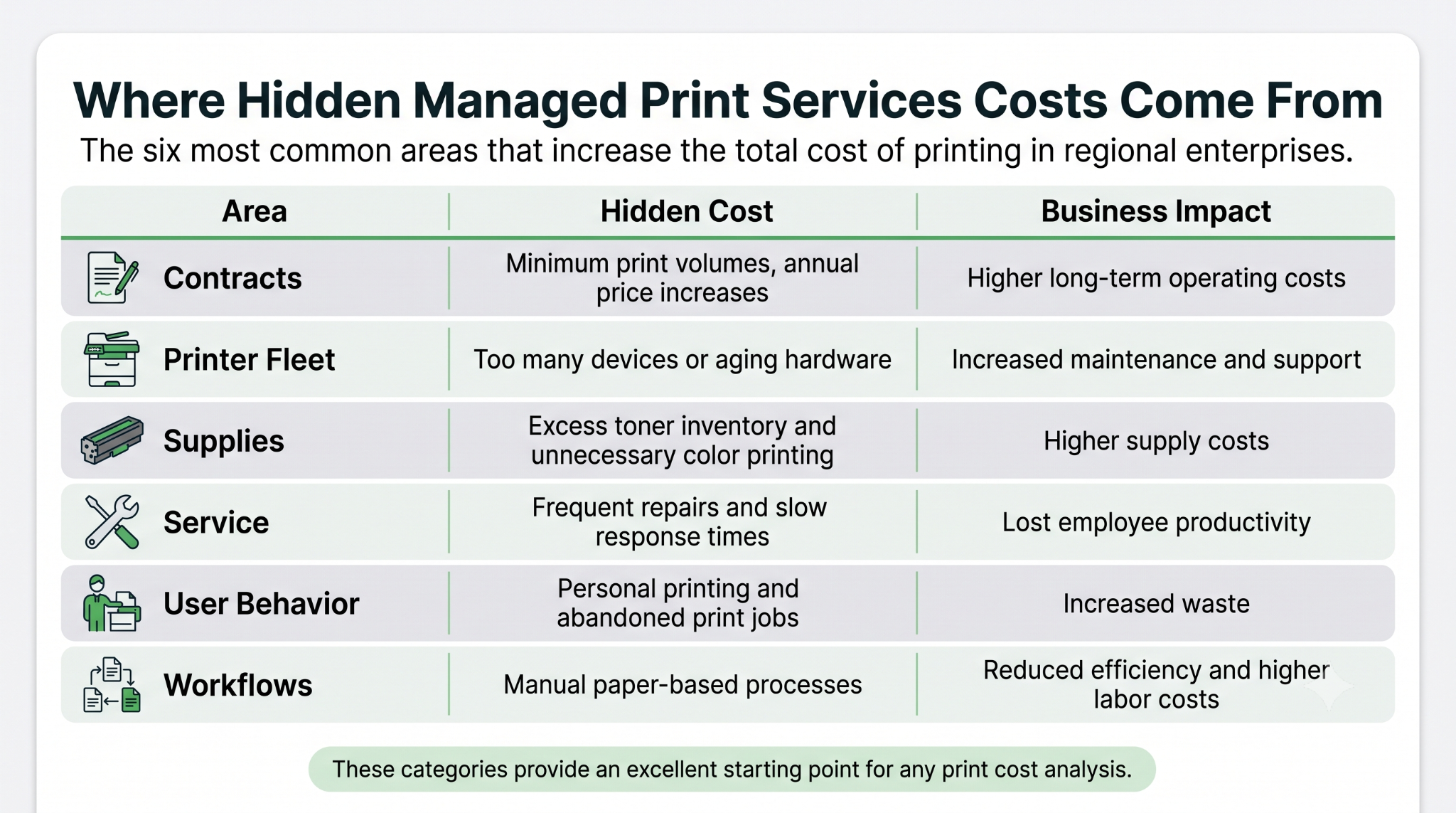
These costs often come from inefficient device placement, outdated equipment, excessive color printing, unnecessary service calls, poorly structured contracts, and manual document processes. Individually, they may seem minor. Collectively, they can add thousands of dollars to annual operating expenses.
Rather than viewing print as a collection of devices, successful organizations evaluate it as an ongoing business process that affects productivity, IT resources, security, and operational efficiency.
Where do hidden printing costs usually come from?
How can you identify hidden MPS costs?
The best way to uncover MPS hidden costs is through a structured assessment of your print environment.
Rather than reviewing invoices alone, evaluate how people actually print, where devices are located, and how your current fleet supports business operations.
Review your print volumes
Start by examining at least 12 months of printing data.
Look for trends such as:
- Monthly print volume
- Black-and-white versus color usage
- Department-level printing
- Seasonal spikes
- Declining print demand
Historical data provides a much more accurate picture than estimates and helps identify opportunities to right-size your environment.
Measure device utilization
One of the biggest hidden expenses is an inefficient printer fleet.
Regional enterprises often inherit printers through acquisitions, office expansions, or individual department purchases. Over time, this creates an environment where some devices are overloaded while others sit largely unused.
Questions worth asking include:
- Which printers operate below their recommended monthly volume?
- Which devices require the most service calls?
- Are multiple nearby devices performing identical functions?
- Could several aging printers be replaced with fewer multifunction devices?
Reducing unnecessary devices often lowers maintenance, supply, and support costs while simplifying management.
Organizations evaluating these opportunities can also benefit from a comprehensive Managed Print Services assessment to understand whether their fleet is properly sized for current business needs.
Why do managed print services contracts create hidden expenses?
The advertised cost per page is only one part of the financial picture.
Contract language often has a much greater impact on long-term costs than the initial pricing itself. The most effective print management strategies include reviewing both operational performance and contractual terms before signing or renewing an agreement. Many of the most common contract pitfalls include automatic renewals, minimum print commitments, and uncapped annual price escalators.
Contract terms to review carefully
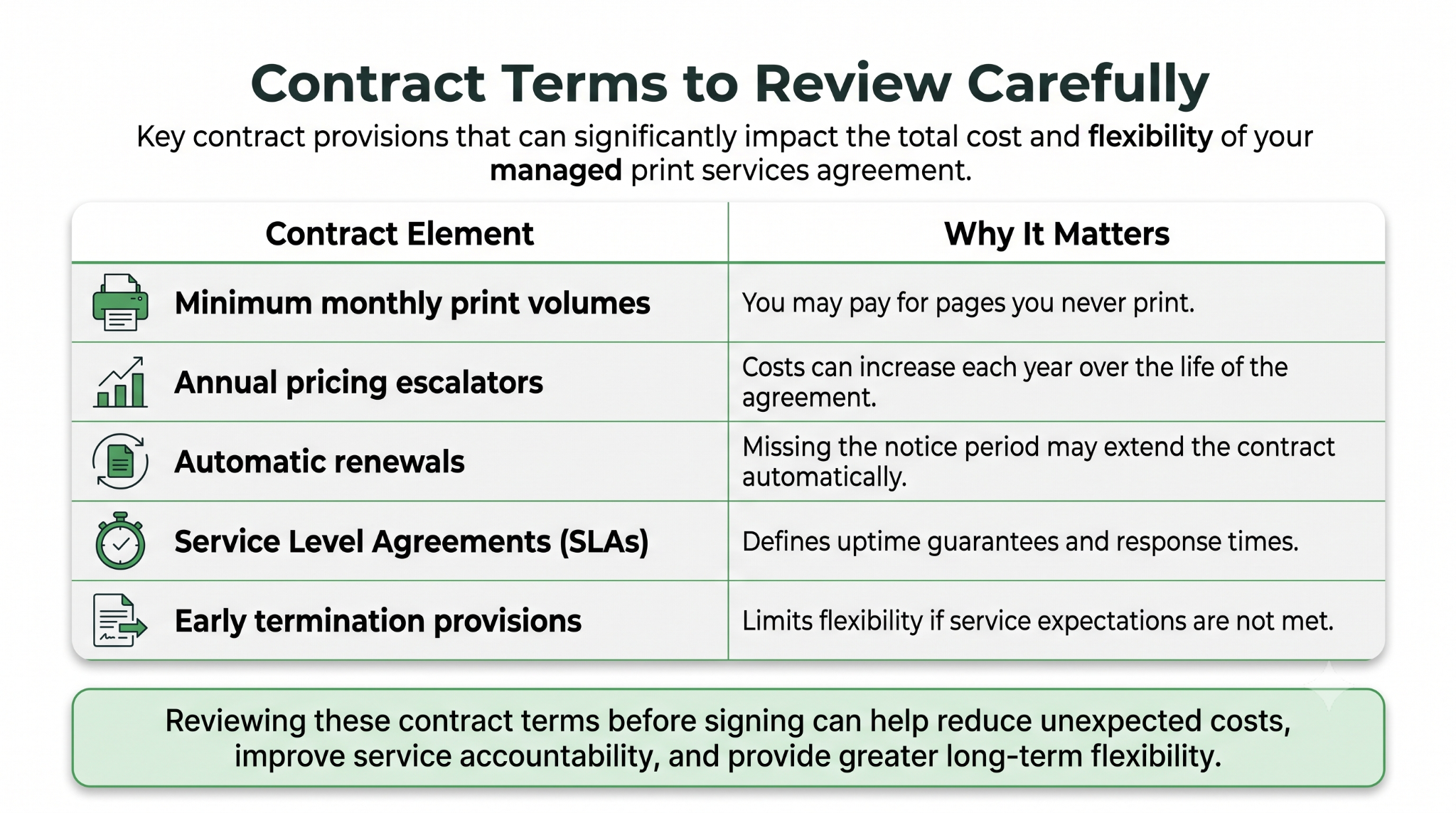 A strong managed print services agreement should clearly define performance expectations, billing methods, support commitments, security responsibilities, and equipment refresh schedules.
How do service and support affect your total print costs?
Printer downtime costs more than repair bills.
Every hour employees wait for a device to be repaired can delay business processes, increase help desk requests, and reduce productivity across departments.
When evaluating a provider, ask questions such as:
- What is the guaranteed response time?
- How is uptime measured?
- Are preventative maintenance visits included?
- How are recurring service issues tracked?
- What reporting is provided after service calls?
Many providers emphasize hardware, but ongoing support is what determines the long-term success of a managed print services program.
According to the University of Washington's Managed Print Services Service Level Agreement guidance, clearly defined uptime expectations and measurable response times are essential components of an effective managed print program.
Can business workflows increase printing costs?
Absolutely.
Many organizations focus only on reducing pages printed while overlooking the manual processes that create unnecessary printing in the first place.
Paper-based approvals, invoice routing, HR onboarding, records management, and document storage often generate far more printing than necessary.
Before investing in additional hardware, evaluate whether the workflow itself can be improved.
For example, organizations digitizing invoices, employee files, or customer records often reduce print volumes while improving document accessibility and security. A Business Workflow Analysis can help identify inefficient processes that continue to drive unnecessary printing across multiple departments.
What print management strategies reduce long-term costs?
Once you've identified hidden expenses, the next step is implementing policies that improve visibility and reduce waste over time.
The most successful regional enterprise IT teams treat print management as an ongoing optimization initiative rather than a one-time project.
Best practices that consistently reduce print costs
- Set black-and-white as the default print setting.
- Enable duplex (double-sided) printing where appropriate.
- Require user authentication for confidential documents.
- Eliminate underutilized printers.
- Standardize device models whenever possible.
- Monitor print trends by department and location.
- Schedule quarterly fleet reviews with your provider.
These strategies not only lower operating costs but also simplify IT management and improve the user experience.
How should regional enterprises evaluate a managed print services provider?
Price should be one factor, not the deciding factor.
A provider that charges slightly more per page may ultimately deliver a lower total cost of ownership through proactive maintenance, strategic fleet optimization, and responsive service.
When comparing providers, consider asking:
- How often will you review our print environment?
- How do you identify opportunities for fleet optimization?
- What reporting is included?
- What security features come standard?
- How do you support organizations with multiple offices?
- What happens if our printing needs change during the contract?
Providers should demonstrate a commitment to continuous improvement rather than simply maintaining your existing fleet.
For organizations with multiple locations, consistency is especially important. Standardized equipment, centralized reporting, and nationwide support can reduce administrative complexity while improving the user experience across every office.
Action Checklist
Use this checklist to uncover and reduce hidden managed print services costs:
☐ Review 12 to 24 months of print volume data.☐ Compare actual usage against contracted minimums.
☐ Identify aging or underutilized devices.
☐ Audit color printing by department.
☐ Review service history for recurring issues.
☐ Verify SLA response times and uptime commitments.
☐ Evaluate contract renewal and pricing escalation terms.
☐ Assess opportunities to digitize paper-based workflows.
☐ Schedule a fleet assessment before your next contract renewal.
Frequently Asked Questions
What are managed print services?
Managed print services are outsourced programs that manage an organization's printers, copiers, supplies, maintenance, monitoring, and reporting. The goal is to reduce costs, improve reliability, strengthen security, and allow internal IT teams to focus on higher-value initiatives.
What causes hidden managed print services costs?
Hidden costs typically result from inefficient contracts, oversized printer fleets, aging equipment, excessive color printing, recurring service issues, and manual document workflows. While these expenses may not appear obvious on monthly invoices, they often represent a significant portion of an organization's total print spend.
How often should a regional enterprise perform a print cost analysis?
Most organizations benefit from conducting a comprehensive print cost analysis at least once a year. Businesses experiencing rapid growth, acquisitions, or office consolidations should consider more frequent reviews to ensure their print environment continues to support operational needs efficiently.
Can managed print services improve document security?
Yes. Modern managed print services often include secure print release, user authentication, encrypted communications, firmware management, and secure device retirement. The National Institute of Standards and Technology (NIST) also recommends approved media sanitization practices before storage devices are reused or disposed of: https://csrc.nist.gov/pubs/sp/800/88/r1/final.
What should I look for in a managed print services contract?
Review pricing structure, minimum print commitments, service level agreements, response times, renewal provisions, equipment refresh policies, security responsibilities, and reporting capabilities. A transparent contract should clearly define expectations for both parties and minimize unexpected costs throughout the agreement.
How can workflow improvements reduce printing costs?
Many printing expenses originate from inefficient business processes rather than the printers themselves. Digitizing approvals, invoices, employee records, and document storage reduces unnecessary printing while improving accessibility, collaboration, and operational efficiency.
Final Thoughts
Hidden printing costs rarely stem from a single issue. More often, they accumulate through outdated contracts, inefficient fleets, unnecessary printing, and manual workflows that no longer fit how modern organizations operate.
By taking a proactive approach to managed print services, regional enterprises can improve visibility, reduce operating costs, and create a more scalable print environment that supports future growth.
If you're evaluating your current print environment or preparing for a contract renewal, Green Office Partner offers complimentary print assessments that help organizations uncover hidden costs, optimize their printer fleets, and standardize office technology across one location or hundreds.
.png)
.png)